

Share this
by D1CU on Jul 21, 2026
The DHS Final Rule officially ends Duration of Status (D/S) for new F-1 students beginning around September 15, 2026. Instead of remaining in the U.S. under an open-ended "Duration of Status," eligible students will receive a fixed admission period tied to their Form I-20 and may need to submit an I-539 Extension of Stay application if they require additional time to complete their program.
"Should I file an I-539 before the new Duration of Status rule?"
It depends on your expected graduation date and immigration timeline. Many current F-1 students covered by the transition provisions may not need to file Form I-539 immediately. However, students whose academic programs extend beyond their authorized admission period, who require additional study time, or who need to remain in the United States beyond their fixed end date may need to submit an I-539 Extension of Stay application before their authorized stay expires.
Filing eligibility depends on individual circumstances, so consult your Designated School Official (DSO) or a qualified immigration attorney before making immigration decisions.
In this guide, you'll learn how the new Duration of Status rule affects F-1 students, whether you should file an I-539 Extension of Stay, key deadlines and costs, common filing mistakes, and how to maintain your lawful status under the new regulations.

1. The Biggest Immigration Change for F-1 Students in Years
The U.S. Department of Homeland Security (DHS) has finalized one of the most significant immigration policy changes affecting international students in recent years.
Beginning approximately September 15, 2026, the long-standing Duration of Status (D/S) admission policy will largely end for new F-1 students.
For decades, most international students admitted under F-1 status were allowed to remain in the United States for the duration of their academic program, as long as they maintained lawful status and complied with SEVP regulations.
Under the new Final Rule, that changes.
Instead of receiving an open-ended Duration of Status admission, eligible students will receive a fixed admission period, generally tied to the end date listed on their Form I-20, subject to regulatory limits. Students who cannot complete their studies before that authorized period expires may need to request an Extension of Stay (EOS) through USCIS Form I-539.
For many students, this introduces an entirely new immigration planning process.
Rather than simply extending their I-20 through their school, some students may also need approval from USCIS to continue studying legally in the United States.
Planning Ahead Matters More Than Ever
If you're unsure whether the new rule affects your graduation timeline, start preparing now. Understanding your options before your authorized stay expires can help you avoid unnecessary immigration complications, maintain lawful status, and make informed decisions about your next steps in the U.S.
2. What Is Form I-539?
Form I-539, officially known as the Application to Extend/Change Nonimmigrant Status, is the form used by eligible nonimmigrants to request additional authorized stay in the United States.
For F-1 students under the new rule, Form I-539 becomes especially important because it serves as the primary method for requesting an Extension of Stay (EOS) when additional time is needed beyond the authorized admission period.
Unlike previous years, where many students only needed an updated Form I-20 from their school, the Final Rule introduces situations where USCIS approval may also be required before remaining in the country beyond the fixed admission period.
Common situations where students may eventually need to file Form I-539 include:
- Unexpected academic delays
- Research or thesis extensions
- Program completion taking longer than expected
- Medical or personal circumstances affecting enrollment
- Other qualifying situations recognized by USCIS
Remember that filing Form I-539 is not automatic and approval is not guaranteed. Each application is reviewed individually by USCIS based on eligibility and supporting documentation.
3. Why This Matters for Day 1 CPT Students
Many students attending Day 1 CPT universities choose programs that align with long-term career goals while maintaining lawful F-1 status.
The new Duration of Status rule does not eliminate Day 1 CPT, and DHS specifically noted that changes to CPT were outside the scope of this rulemaking.
However, the rule does change how students should plan their academic timeline.
Students enrolled in longer master's or doctoral programs should review:
- Their current Form I-20 end date
- Expected graduation timeline
- Any anticipated program extensions
- Whether additional USCIS filings may eventually be required
If you're still comparing universities, it's also worth evaluating programs with flexible schedules and strong DSO support.
4. Who Should Start Thinking About Filing an I-539?
Although not every international student will need to file immediately, now is the time to understand where you stand.
Generally, you begin discussing an Extension of Stay strategy with your DSO if:
- Your academic program may extend beyond your authorized admission period
- You anticipate delays in graduation
- You are considering changing academic plans
- You expect to remain in the U.S. longer than originally planned
- You want to avoid last-minute USCIS filings
Waiting until your authorized stay is about to expire could significantly reduce your options.
The good news is that many current students are protected by transition provisions under the Final Rule, but understanding those timelines early can help you avoid unnecessary stress later.
5. Should You File an I-539 Before September 15, 2026?
The answer depends on when you were admitted to the United States, when your academic program ends, and whether you are covered by the Final Rule's transition provisions.
The good news is that not every international student will need to file Form I-539 immediately. DHS included transition rules to help many current students move from the old Duration of Status (D/S) system to the new fixed admission period without requiring an immediate Extension of Stay application.
However, some students should begin preparing now—especially if they expect their studies to continue beyond their authorized admission period or anticipate delays in completing their degree.
The table below provides a general overview.
Do You Need to File an I-539?
| Your Situation | Do You Need to File an I-539? |
|---|---|
| You expect to graduate before your authorized admission period ends. | Probably not immediately. Continue following your DSO's guidance and maintain your F-1 status. |
| Your academic program may extend beyond your authorized admission period. | Possibly. You may need to file an Extension of Stay before your current period expires. |
| You need additional time because of research, a thesis, or academic delays. | Likely yes, if your authorized stay will expire before you complete your program. |
| You're beginning a new F-1 program after the rule takes effect. | Depends. Your admission will generally follow the new fixed-period framework established by the Final Rule. |
| You're currently covered by the transition provisions. | Not necessarily. Review your timeline with your DSO to determine whether future USCIS filings will be required. |
Current Students vs. New Students
One of the most common questions is whether the Final Rule affects students who are already studying in the United States.
The answer depends largely on when you were admitted.
Current Students
Many students who are already in F-1 status before the rule becomes effective will continue under the Final Rule's transition provisions.
In general, DHS allows these students to keep their current program end date, subject to the transition framework outlined in the Final Rule. Students admitted under Duration of Status on the effective date generally retain their current program end date, up to four years from the effective date, along with the previously permitted departure period.
That means many students will not need to file an immediate I-539 Extension of Stay simply because the rule has changed.
However, if your studies continue beyond your authorized admission period or you later need additional time to complete your program, you may need to submit an Extension of Stay application with USCIS.
New Students
Students entering the United States after the Final Rule takes effect will generally be admitted for a fixed period rather than Duration of Status.
Instead of remaining in the U.S. indefinitely while maintaining student status, your authorized stay will be tied to the period granted under the new regulations and your academic program.
If you need additional time beyond that authorized period, you may need to file Form I-539 before your stay expires.
6. What Happens If You Wait Too Long?
One of the biggest mistakes international students make is waiting until the last minute to consider an Extension of Stay.
Although USCIS accepts Form I-539 applications from eligible applicants, approval is discretionary and depends on whether you continue to meet all eligibility requirements.
Waiting too long may result in:
- Losing eligibility to extend your stay before your authorized admission expires.
- Interruptions to your academic program.
- Additional USCIS requests for evidence (RFEs).
- Accruing unlawful presence if you remain beyond your authorized period without maintaining lawful status.
Planning ahead gives you more time to gather documents, work with your DSO, and understand whether an Extension of Stay application is appropriate for your situation.
7. How Much Does an I-539 Extension of Stay Cost?
Before deciding whether to file Form I-539, it's important to understand the potential costs.
| Expense | Estimated Cost |
|---|---|
| Form I-539 Filing Fee (Online) | $420 |
| Form I-539 Filing Fee (Paper) | $470 |
| Premium Processing (Optional, Form I-907) | $2,075 |
| Immigration Attorney Fees (Typical Range) | Approximately $500–$2,500 |
Keep in mind that attorney fees vary depending on the complexity of your case. Some students with straightforward applications may choose to prepare the filing themselves, while others prefer professional guidance to reduce the risk of delays or errors.
8. Processing Times: Why Filing Early Matters
Another important consideration is processing time.
A timely filed I-539 Extension of Stay application generally allows eligible applicants to remain in the United States while USCIS reviews the request, but it does not guarantee approval or faster processing.
Current processing times can vary significantly depending on the USCIS service center and overall application volume.
For many students, the biggest risk is waiting too long to prepare than the filing itself.
If you think your program may extend beyond your authorized stay, begin speaking with your DSO well before your current admission period expires.
Planning Ahead Can Save You Months of Uncertainty
The new Duration of Status rule makes immigration planning more important than ever. Understanding your timeline early gives you more options, helps you stay compliant with U.S. immigration requirements, and reduces the likelihood of unexpected status issues later.
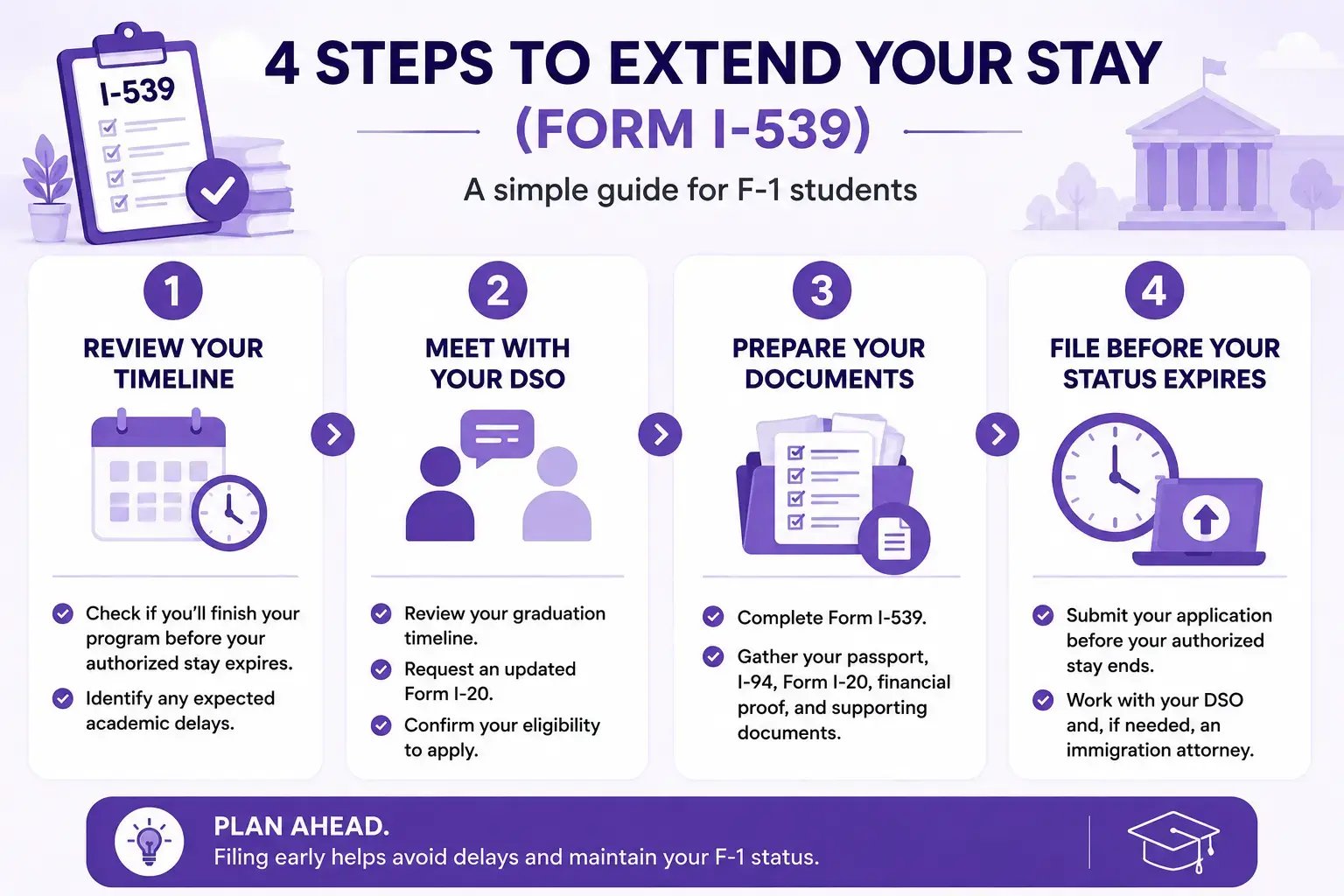
9. How to File an I-539 Extension of Stay
If you determine that you need additional time to complete your academic program, you'll generally need to submit Form I-539, Application to Extend/Change Nonimmigrant Status, to USCIS before your authorized stay expires.
Although every student's situation is different, the filing process typically follows these steps.
Step 1: Review Your Program Timeline
Before preparing your application, review your expected graduation date and compare it with the authorized admission period shown on your immigration documents.
Ask yourself:
- Will I finish my degree before my authorized stay expires?
- Has my expected graduation date changed?
- Do I anticipate research, thesis, internship, or academic delays?
- Has my DSO recommended extending my academic program?
Answering these questions early gives you more time to prepare the appropriate documentation if an Extension of Stay becomes necessary.
Step 2: Meet With Your Designated School Official (DSO)
Your DSO plays an important role in maintaining your F-1 status.
Before filing Form I-539, schedule a meeting to discuss:
- Your expected graduation timeline
- Your updated Form I-20
- Whether you qualify for an Extension of Stay
- Any additional documentation USCIS may require
Remember that an updated Form I-20 alone may not be enough under the new rule if USCIS approval is also required.
Step 3: Prepare Your Supporting Documents
Although documentation varies by case, applicants commonly prepare:
- Completed Form I-539
- Current passport
- Form I-94 Arrival/Departure Record
- Updated Form I-20
- Proof of financial support
- Explanation letter describing why additional time is needed
- Any supporting academic documentation requested by the school
Submitting complete and accurate documentation can help reduce delays or Requests for Evidence (RFEs).
Step 4: File Before Your Authorized Stay Expires
Timing is one of the most important parts of the application.
Students should generally submit an Extension of Stay application before their authorized admission period expires.
Waiting until the last minute can create unnecessary stress and may reduce your available options if additional documents are requested.
Because every situation is unique, work closely with your DSO and, when appropriate, an immigration attorney before filing.
10. Common Mistakes to Avoid
Many Extension of Stay applications are delayed because students wait too long or misunderstand the new requirements.
Here are some of the most common mistakes to avoid.
❌ Waiting Until the Last Minute
The new rule makes advance planning more important than ever.
If your program may extend beyond your authorized stay, begin discussing your options months—not weeks—before your admission period expires.
❌ Assuming Every Student Needs an I-539
Not every F-1 student will need to file an Extension of Stay immediately.
Many students already studying in the United States are covered by transition provisions under the Final Rule. Understanding your individual timeline is more important than assuming everyone follows the same process.
❌ Relying Only on Your Form I-20
Under the previous Duration of Status system, many students only needed an updated Form I-20 when their academic program changed.
Under the Final Rule, some students may also require USCIS approval through Form I-539 before remaining in the United States beyond their authorized admission period.
❌ Filing Without Understanding the Transition Rules
One of the biggest misconceptions is believing the Final Rule affects every student in exactly the same way. Current students, incoming students, OPT participants, and students nearing graduation may all fall under different provisions of the rule.
Understanding which category applies to you can help you avoid unnecessary filings and better plan your next steps.
11. Frequently Asked Questions
1. Do all F-1 students need to file Form I-539 under the new rule?
No. Not every international student will need to submit an I-539 Extension of Stay application immediately. Many students already studying in the United States are covered by transition provisions in the Final Rule.
However, students who need additional time beyond their authorized admission period may need to file Form I-539 before their stay expires. Always review your situation with your Designated School Official (DSO) or a qualified immigration attorney.
2. When should I file an I-539 Extension of Stay?
You should generally file Form I-539 before your authorized admission period expires. Waiting until the last minute may reduce your options and increase the risk of delays if USCIS requests additional documentation.
3. How much does Form I-539 cost?
As of 2026, the USCIS filing fee for Form I-539 is:
- $420 for online filing
- $470 for paper filing
Additional costs may apply if you choose to work with an immigration attorney or need supporting documentation.
4. Can I stay in the United States while my I-539 is pending?
In many situations, a timely filed Extension of Stay application allows applicants to remain in the United States while USCIS processes the request.
However, filing Form I-539 does not automatically guarantee approval, and applicants must continue meeting all eligibility requirements throughout the process.
5. Does the new Duration of Status rule affect Day 1 CPT?
The Final Rule does not eliminate Day 1 CPT. DHS specifically stated that changes to Curricular Practical Training (CPT), including Day 1 CPT, were outside the scope of this rulemaking.
However, students enrolled in Day 1 CPT programs should still understand how the new fixed admission period and Extension of Stay requirements may affect their long-term academic planning.
12. Final Thoughts
The publication of the Duration of Status Final Rule marks one of the most significant immigration changes for international students in decades.
While many current F-1 students will benefit from transition provisions, the shift from Duration of Status (D/S) to a fixed admission period means immigration planning is becoming more important than ever. Students who expect delays in completing their degree, pursuing research, or extending their academic program should begin discussing their options with their DSO well before their authorized stay expires.
Understanding whether you need to file Form I-539, preparing the correct documentation, and staying informed about USCIS requirements can help you avoid unnecessary complications and maintain your lawful F-1 status.
The earlier you begin planning, the more flexibility you'll have when making important academic and immigration decisions.
Continue Planning Your Next Steps
The new Duration of Status rule may raise questions about maintaining lawful status, extending your stay, or planning your next academic move.
Visit extensionofstay.com to access free legal immigration webinars, expert guides, practical planning resources, and exclusive educational content to help you confidently prepare your Extension of Stay.
Share this

DHS Duration of Status Rule Blocked: Key Update for Day 1 CPT Students
Navigating New D/S Rule: Choosing the Right Day 1 CPT Master’s Program
Top Day 1 CPT DBA Doctoral Programs for International Students in 2026

Not Selected in H-1B: Can the New Rule Help You Stay?


.png?width=204&height=68&name=Verified%20(2).png)